
If you’re ever in the region of Siena, Italy, you can visit an actual sword in the stone (but you can’t try to pull it out, sorry).
The Abbey of San Galgano is tucked away in a river valley, situated between two Tuscan towns. Founded by Galgano Guidotti, it was built in the 13th century as a Cistercian monastery. I could try to explain the Cistercian religious order, but that would involve a semester class in the history of Catholic monasticism. To put it simply, the Cistercians were a group of monks and nuns that believed current monastic practices had gotten too liberal. They restored what they believed was the original intent of the Rule of Saint Benedict (a 500 year old book of monastic precepts).
The Cistercians followed the Rule of Saint Benedict literally, and sometimes in a strict austerity that went beyond the Rule. Their practices involved a simple life of work, love, prayer and self-denial. Manual labor was particularly important, especially working out in the fields. The Cistercians became incredibly good at hydraulic engineering (water flow, sewage, dams, and such). The systems they developed are still in use today. Whenever you turn on your water faucet, be sure to thank the Cistercians.
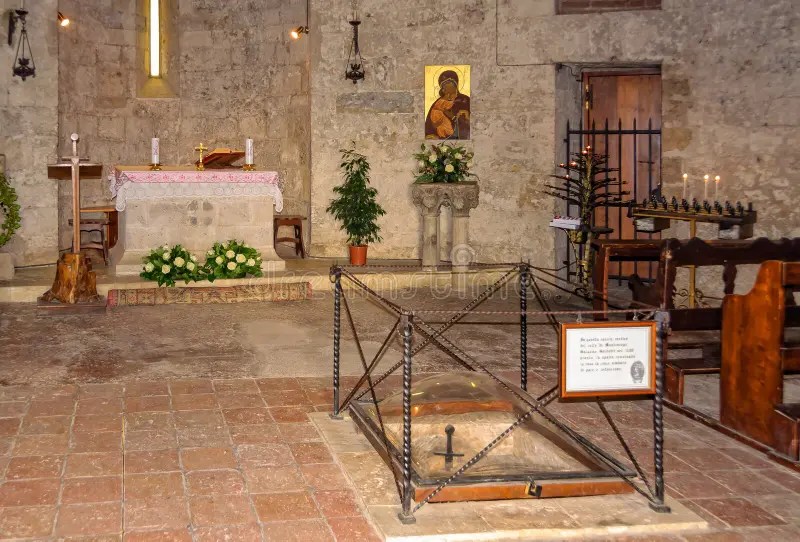
What does this have to do with a sword in the stone? There are two stories. The first is that Galgano was guided by an angel to a rugged hill. Once there, he had a vision of a temple on the hill. The angel urged Galgano to repent of his sins, but Galgano complained that it would be an impossible task as hard as driving a sword into a stony outcropping. To prove his point to the angel, he thrust his own sword at a large chunk of stone. The sword slid smoothly into the stone, where it still remains to this day (as the story goes). Galgano founded a church there and became one more person who learned the lesson that you shouldn’t argue with angels.
The second story? Next time. Next time.